
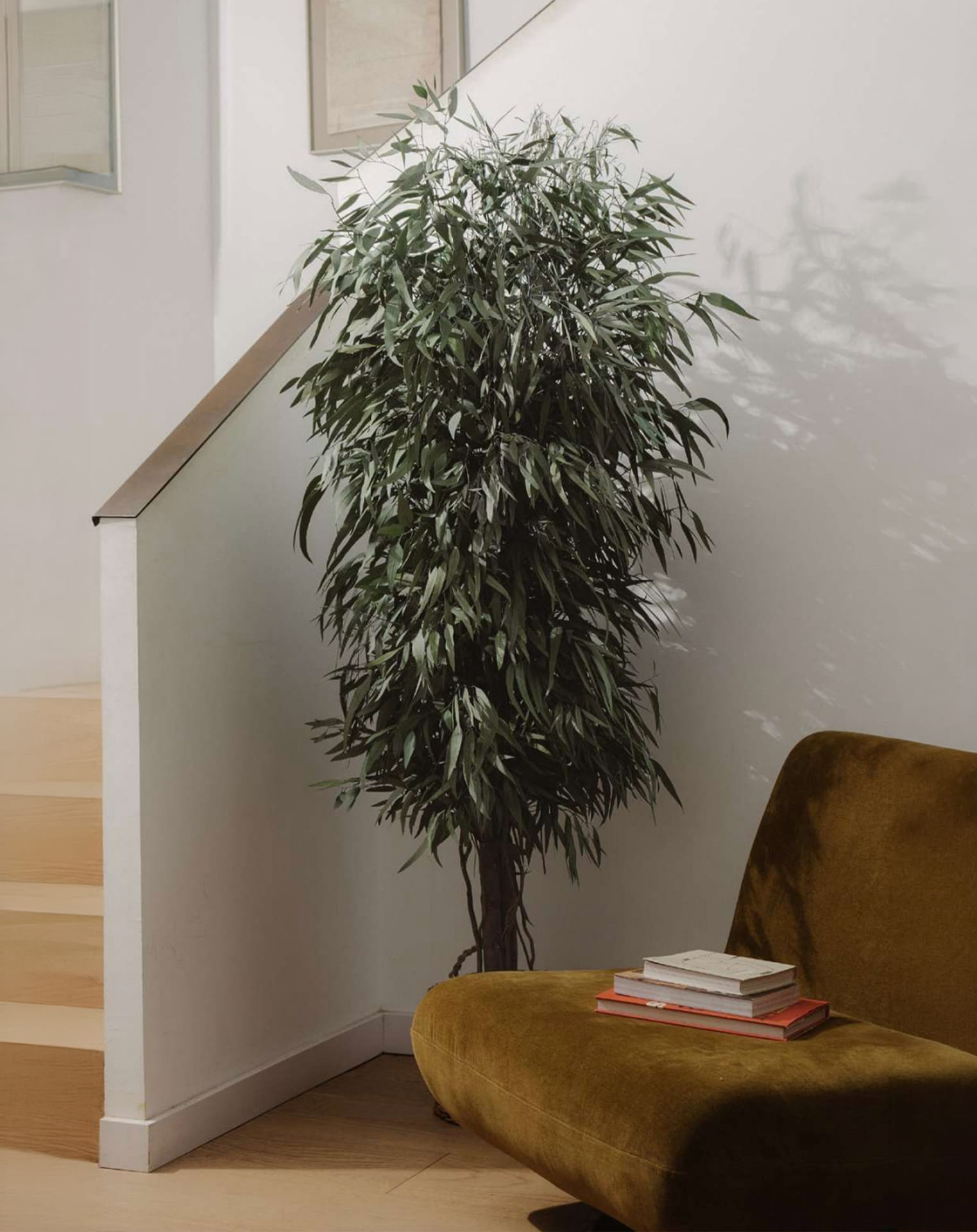
There is a moment most plant owners know well. You return from a two-week trip, open the front door, and find the living room looking like a small botanical tragedy. Yellowed leaves, dry soil, a spider plant that has very clearly given up.
Preserved plants exist to solve exactly this problem — but not in the way you might expect. They are not plastic. They are not silk. They are real plants, and understanding what that means changes how you think about interior greenery entirely.
What are preserved plants?
Preserved plants are genuine botanical specimens — real leaves, real stems, real moss — treated with a plant-based glycerin solution that halts their biological processes and replaces the natural moisture in the tissue. The result is a plant that holds its natural appearance, texture, and colour for years, requiring no water, no sunlight, and no maintenance of any kind.
A well-preserved plant from a quality producer will look and feel exactly like a living specimen. It is simply no longer alive in the biological sense — but it will not wilt, shed, or change.
Where Arborea’s preserved plants come from
Arborea sources its entire range from Verdissimo, a Spanish producer recognised as the world’s leading manufacturer of preserved plants. Founded in Murcia, Spain, Verdissimo works with botanists and preservation chemists to refine the glycerin treatment process to commercial scale — their method is patented and uses plant-based glycerin and natural dyes throughout. In April 2026, Verdissimo received Florverde certification from NaturaCert, the Floriculture Sustainability Initiative’s independent sustainability standard, covering both their farms and post-harvest preservation processes.
Arborea brings Verdissimo’s preserved plants to the Baltics and the Nordics, with showrooms in Tabasalu and Tartu and delivery across Estonia and Finland. Every tree, bush, and moss panel in the Arborea range comes from this same supply chain — which is why the quality of the product is consistent, and why the lifespan holds. If you have questions about individual products or sizing, the Arborea FAQ covers the most common ones.
How the preservation process works
The science behind preserved plants is straightforward, though the execution at commercial scale requires precision. The fundamental mechanism has been studied and documented in botanical literature: glycerin replaces the water content in plant tissue, and the plant’s own transpiration process draws the solution through the stem system into every part of the specimen (Kansas State University Extension, MF2446).
Step 1: Harvest at peak. Plants are selected and harvested at the height of their growth cycle — when leaves are fully developed and stems are mature enough to absorb the treatment solution. Immature tissue cannot take up the glycerin effectively.
Step 2: Glycerin absorption. The freshly cut stems are placed in a preserving solution based on plant-derived glycerin. Through the same process that normally moves water through a plant, the solution travels up the stems and gradually replaces the natural sap in every cell. Depending on the species, this takes a few days.
Step 3: Colour stabilisation. Glycerin disrupts chlorophyll, which causes natural green tones to fade. Plant-safe dyes are introduced into the solution to restore the original colour and ensure consistency across batches. At Verdissimo’s scale, this colour calibration is handled with industrial precision, producing the deeply saturated greens that distinguish premium preserved plants from lower-quality alternatives.
Step 4: Drying and quality control. Once the treatment is complete, the plant material is dried, inspected, and prepared for use. The result is soft to the touch, flexible, and visually indistinguishable from a living specimen.
The entire process takes days, not hours. That investment in process time is part of why quality-tier preserved plants — sourced from producers like Verdissimo — carry a substantially higher lifespan than budget alternatives found in mass-market retail.
Preserved plants vs artificial plants vs living plants
This is the comparison that matters most for anyone making a decision about interior greenery. The differences are significant.
| Preserved plants | Artificial plants | Living plants | |
|---|---|---|---|
| Origin | Real botanical specimens | Synthetic materials (plastic, silk, foam) | Living organisms |
| Maintenance | None | None (occasional dusting) | Regular watering, light, feeding |
| Lifespan | 5+ years indoors | 10+ years (colour fades) | Indefinite (with care) |
| Look and feel | Natural: soft, textured, organic | Synthetic: uniform, often glossy | Natural and variable |
| Touch test | Passes | Does not pass | Passes |
| Light requirement | None | None | Moderate to high |
| Indoor/outdoor | Indoor only | Indoor/outdoor | Varies |
| Cost over time | Low (no ongoing costs) | Low | Moderate (soil, pots, replacements) |
| Air quality impact | Neutral | Neutral | Minor improvement |
The critical distinction between preserved and artificial plants is origin. A preserved plant began as a living specimen — its cell structure, its stem texture, its leaf geometry are all botanical. An artificial plant is manufactured from scratch. When you run your hand across a preserved eucalyptus branch, you are touching real eucalyptus; the shape and texture of each leaf is unique. No two branches are identical.
This difference is immediately apparent to most people who handle preserved plants for the first time. It is also why they are frequently mistaken for living plants — particularly when styled well in a home or office environment.
How long do preserved plants last?
A well-made preserved plant, kept indoors and away from direct sunlight, humidity, and handling, will maintain its appearance for 5 years or more.
This figure comes with one important condition: the quality of the preservation determines the lifespan. Plants sourced from industrial-scale producers like Verdissimo, where the glycerin concentration, dye formulation, and drying process are tightly controlled, consistently deliver this lifespan. Budget preserved plants — often found in homewares chains and discount retailers — may begin to fade or lose structure within 12 to 18 months.
The factors that shorten preserved plant lifespan:
- Direct sunlight — UV radiation bleaches the natural dyes over time, causing colour fade
- High humidity — excess moisture can cause glycerin to “bleed” from the stems, leaving a sticky residue and softening the structure
- Handling — the preservation treatment is robust, but repeated touching and repositioning gradually damages the plant tissue
- Water contact — preserved plants should never be watered, misted, or placed near a water source (this is especially important for specimens in gypsum pots, which are water-soluble and designed strictly for indoor use)
Under normal indoor conditions — a sitting room, an office, a hotel lobby — preserved plants require no active management at all. The usual maintenance routine is occasional dusting with a soft brush or compressed air, perhaps twice a year.
Where preserved plants work best
The defining characteristic of preserved plants — zero maintenance, no light requirement — makes them suitable for environments where living plants would struggle or simply be impractical.
Private homes. Preserved trees and large-format bushes are increasingly used as focal points in living rooms, hallways, and bedrooms where scale matters but the daily commitment of a living plant is not realistic. A preserved olive tree in a corner requires nothing from you, day after day, for years.
Office environments. Biophilic design — the integration of natural elements into built environments — has measurable effects on how people experience workspaces. A 2025 study published in Work found that offices pairing indoor plants with other biophilic elements showed improvements in employee mood and sleep quality (EBSCO, 2025). A parallel 2025 study in Frontiers in Psychology found biophilic design raised perceived restorativeness in home living spaces, linking the effect to occupant wellbeing (Frontiers in Psychology, 2025). Preserved plants deliver the visual and tactile quality of living plants in spaces where watering schedules, grow lights, and plant maintenance are not feasible.
Hospitality and commercial spaces. Hotels, spas, restaurants, and retail environments benefit from the consistency of preserved plants — they look the same in month one and month forty-eight, require no specialist maintenance, and can be installed in locations with no natural light at all.
Interior designers and architects. For professionals specifying greenery in projects, preserved plants offer something that living plants cannot: certainty. The plant will look like the render on completion day, and six months later, and three years later.
What preserved plants cannot do
Transparency here matters. Preserved plants are not a perfect substitute for living plants in every context.
They do not improve air quality. The claim that indoor plants meaningfully filter air pollutants — derived from a 1989 NASA study conducted in sealed chambers — has not been replicated under normal office or home ventilation conditions. At realistic plant densities and typical air exchange rates, the effect is negligible. Preserved plants do not metabolise at all. If your primary goal is air purification, living plants are the right choice, though the scientifically verified effect in real spaces is modest.
They are not suitable for outdoor use. The glycerin treatment and, in many cases, the gypsum pots used as planters are not weather-resistant. Moisture, rain, and direct sun exposure will damage the plant and degrade the planter. All preserved plants are strictly indoor products.
They do not change. This is a feature for most applications — consistency is precisely the point — but some spaces benefit from the seasonal variation and growth that living plants provide. In those contexts, living plants remain the better choice.
Frequently asked questions
Are preserved plants real plants?
Yes. Preserved plants are genuine botanical specimens that have been treated with a glycerin-based solution to halt biological activity. They are not synthetic. The stems, leaves, and structure are all original plant material — only the life processes have been stopped. This is why they look and feel different from artificial plants, which are manufactured from plastic or fabric.
Do preserved plants need water?
No — and they should not receive any. Watering a preserved plant will reverse the preservation process, causing the plant to deteriorate. Preserved plants require no water, no feeding, and no misting. They should also be kept away from humid environments like bathrooms or kitchens where steam and moisture are frequent.
Do preserved plants smell?
Fresh preserved plants may carry a faint glycerin smell when first unpacked, which typically dissipates within a few days in normal ventilation. After that, they are odourless. They do not carry the earthy or botanical scent of a living plant.
Can preserved plants be used outdoors?
No. Preserved plants are strictly indoor products. The glycerin treatment makes the plant tissue moisture-sensitive, and many planters — including the gypsum pots used by Verdissimo and stocked by Arborea — are water-soluble by design. Outdoor conditions will destroy both the plant and the planter.
How much do quality preserved plants cost?
Pricing varies by size and species. Entry-level preserved plants — small moss panels, bunches, and decorative items — typically start from €60–100. Full-size preserved trees (1–2 metres) in the Arborea range are priced from approximately €220 to €740 depending on species and configuration. The price reflects the labour-intensive production process and the lifespan the product delivers: spread over five years, a preserved tree represents good value against the ongoing cost of replacing living plants.
Where can I see preserved plants before buying?
Arborea has showrooms in Tabasalu (near Tallinn) and Tartu where the full range — including full-scale trees, bushes, and moss panels — is available to see and handle in person. This is strongly recommended for anyone considering a large-format piece; the scale and quality of preserved plants is best appreciated in person.
The case for preserved plants
Interior greenery has a consistent effect on how spaces feel — the texture, the organic geometry of plant forms, the visual depth that a large-scale tree or bush brings to a room. Living plants deliver this, but they require a sustained commitment that many homes, offices, and commercial spaces cannot reliably maintain.
Preserved plants are not a compromise. At the quality tier produced by Verdissimo and supplied by Arborea, they deliver the same visual and tactile result as living plants, in spaces that living plants cannot reach, for a lifespan measured in years rather than growing seasons.
The logic is simple: a preserved plant looks like a living plant on the day it is installed, and it looks the same five years later. No specialist knowledge, no equipment, no schedule. Just greenery that stays.
Browse the Arborea range of preserved trees, bushes, and moss panels — or visit one of our showrooms to see the full selection at full scale.
All Arborea preserved plants are sourced from Verdissimo, Spain — the world’s leading producer of preserved botanical specimens. Products are designed for indoor use only.